
The German Asien-Korps, K-Flak Battery No. 15.
Nazareth, Palestine, April 1918.
This Battery consisted of two 7.7-cm L/27 K-Flak 14 Daimler-Krupp, a Command Car and three truks.

This Blog is dedicated to the Anti-Aircraft Artillery of all the belligerent countries of the First World War, also the neutral and non-belligerent countries.

German Ehrhardt-Rheinmetall Self-Propelled Anti-Aircraft Gun
(K-Flak 14) No. 59

7.7-cm FK 96 n/A Flak ‘Schnetzler-Sockel' System M1916, of the Imperial German Navy.
Three anti-aircraft guns belonging to a Battery of the German Imperial Navy. The platforms or mounts 'Schnetzler-Sockel' have been modified with obvious differences with the standard models, among others simplifying the lifting mechanisms of the pieces. Flanders, Belgium, probably in 1917.
*****************
7,7-cm FK 96 n/A Flak ‘Schnetzler-Sockel' Sistema M1916, de la Marina Imperial Alemana.
Tres cañones antiaéreos pertenecientes a una Batería de la Marina Imperial Alemana. Las plataformas o afustes 'Schnetzler-Sockel' han sido modificados con evidentes diferencias con los modelos estándar, entre otros simplificando los mecanismos de elevación de la piezas. Flandes, Bélgica, probablemente en 1917.
*****************
Posted by Jose Luis Castillo © 2022- Anti-Aircraft Artillery in the WWI


A German 7.7-cm 'Feldkanone' 96 n/A field gun, on a makeshift anti-aircraft mount. The cannon rests on a framework of thick wooden planks, firmly tied together with thick ropes. The assembly is capable of rotating 360º on a metal axis located above and in the center of a truncated concrete cone, which serves as the raised base of the anti-aircraft mount.
Note the two guides, possibly made of concrete, which were used to place the barrel on the concrete base, and also to remove the piece when it had to change its location.
********************
Un cañón alemán de campaña de 7,7-cm 'Feldkanone' 96 n/A, sobre un montaje antiaéreo improvisado. El cañón descansa sobre un entramado de gruesos tablones de madera, amarrado firmemente el conjunto con gruesas cuerdas. El montaje es capaz de girar 360º sobre un eje metálico situado arriba y en el centro de un cono truncado de hormigón, que sirve como base elevada del montaje antiaéreo.
Obsérvese las dos guías, posiblemente de hormigón, que servían para emplazar el cañón sobre la base de hormigón, y también para retirar la pieza cuando debía de cambiar de emplazamiento.
********************
Posted by Jose Luis Castillo © 2022- Anti-Aircraft Artillery in the WWI

Improvised Flak twin-wheel system for German 7.7 cm field gun.
One of the rarest German improvisations, adapted to anti-aircraft fire. Possibly inspired by the standard "Köbe-Protze" double wheel system. I have only found two photos of Flaks with double overlapping wheels. Both on the eastern front, including this one. The gun is the standard 7.7-cm field gun.
*********************
Sistema Flak de doble rueda improvisado para cañón de campaña alemán de 7,7 cm.
Una de las improvisaciones alemanas mas raras, adaptadas al tiro antiaéreo. Posiblemente inspirada en el sistema estándar "Köbe-Protze" de doble rueda. Sólo he encontrado dos fotos de Flaks con dobles ruedas superpuestas. Ambas en el frente del Este, incluida ésta. El cañón es el de campaña estándar de 7,7-cm.
Posted by Jose Luis Castillo © 2022- Anti-Aircraft Artillery in the WWI


57-mm L/48 Nordenfelt anti-aircraft gun of the Russian Navy. He was captured by the Germans on the Island of the Moon (Woi), near Oesel Island, in October 1917, during the course of Operation Albion. Four German sailors pose in the 'bunker' that served as a refuge for Russian sailors.
********************
Cañón antiaéreo de 57-mm L/48 Nordenfelt de la Marina Rusa. Fue capturado por los alemanes en la Isla de la Luna (Woi), próxima a la Isla Oesel, en octubre de 1917, durante el transcurso de la Operación Albión. Cuatro marinos alemanes posan en el 'bunker' que servía de refugio a los marineros rusos.
Posted by Jose Luis Castillo © 2022- Anti-Aircraft Artillery in the WWI

German 'Schnetzler-Sockel' Anti-Aircraft System M1916.
Posted by Jose Luis Castillo © 2022- Anti-Aircraft Artillery in the WWI
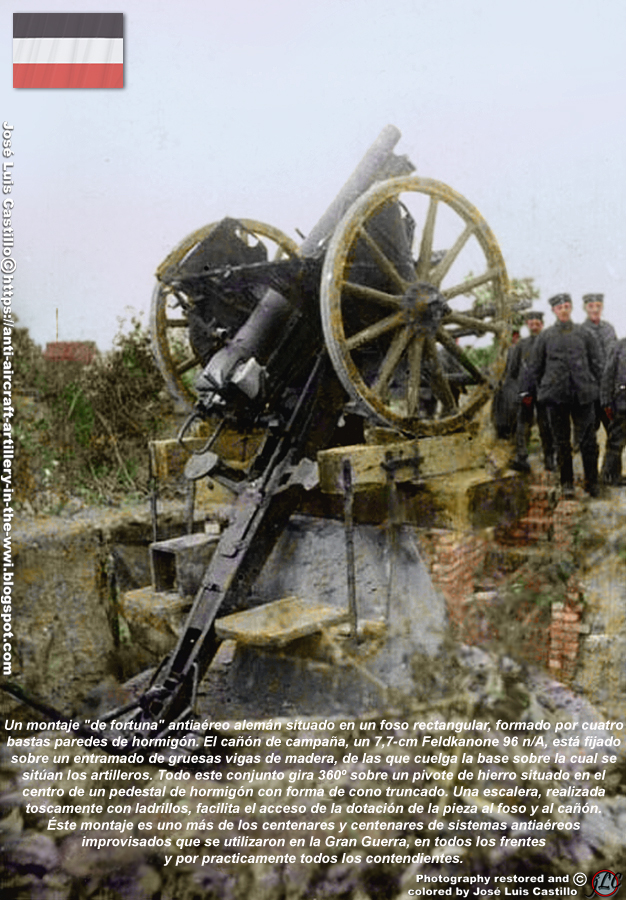
A German anti-aircraft gun in a "fortune mount" located in a rectangular moat, made up of four rough concrete walls. The field gun, a 7.7-cm Feldkanone 96 n/A, is fixed on a framework of thick wooden beams, from which hangs the base on which are placed the gunners. This whole assembly rotates 360º on an iron pivot located in the center of a concrete pedestal in the shape of a truncated cone. A staircase, made roughly with bricks, facilitates the access of the crew of the piece to the pit and the gun. This assembly is one more of the hundreds and hundreds of improvised anti-aircraft systems that were used in the Great War, on all fronts and by practically all the contenders.
***************************
Un cañón antiaéreo alemán en un 'montaje de fortuna' (cañón antiaéreo improvisado).
Un cañón antiaéreo alemán en un "montaje de fortuna" situado en un foso rectangular, formado por cuatro bastas paredes de hormigón. El cañón de campaña, un 7,7-cm Feldkanone 96 n/A, está fijado sobre un entramado de gruesas vigas de madera, de las que cuelga la base sobre la cual se sitúan los artilleros. Todo este conjunto gira 360º sobre un pivote de hierro situado en el centro de un pedestal de hormigón con forma de cono truncado. Una escalera, realizada toscamente con ladrillos, facilita el acceso de la dotación de la pieza al foso y al cañón. Éste montaje es uno más de los centenares y centenares de sistemas antiaéreos improvisados que se utilizaron en la Gran Guerra, en todos los frentes y por prácticamente todos los contendientes.
Posted by
Jose Luis Castillo © 2021- Anti-Aircraft Artillery in the WWI

A German 10,5-cm Field Howitzer (B.a.K.). France 1914.
German 105-mm * Field Howitzer adapted for anti-aircraft shooting. Probably France in 1914.
* 10.5-cm lFH 98-09 Krupp.
******************
Un obús de campaña alemán de 10,5 cm (B.a.K.). Francia 1914.
Obús de Campaña alemán de 105-mm* adaptado al tiro antiaéreo. Probablemente Francia en 1914.
* 10,5-cm lFH 98-09 Krupp.
Posted by Jose Luis Castillo © 2021- Anti-Aircraft Artillery in the WWI


A Platoon (Züg) of German Anti-Aircraft Artillery (Flak), consisting of two 7.7-cm L/35 (franz.97) Modified guns, in which the original French tubes have been replaced by those of the German field gun 7.7-cm L/35 FK 16. They were located on fixed concrete and brick platforms. The anti-aircraft platoon was located at the bottom of the North Canal or in one of its branches, at the height of Moeuvres, a town close to the front and close to Cambrai, France. The photograph was taken after an heavy summer rain and shortly before the British offensive was unleashed, which led to the Battle of the North Canal in September 1918.
******************************
Sección de la Artillería Antiaérea alemana (Flak) situada cerca de Cambrai, Francia 1918.
Una Sección (Züg) de Artillería Antiaérea (Flak) alemana, formada por dos cañones de 7,7-cm L/35 (franz.97) Modificados, en los que han sido sustituidas las cañas (tubos) originales francesas por las del cañón alemán de campaña 7,7-cm L/35 FK 16. Estaban emplazados sobre sendas plataformas fijas de cemento y ladrillo. La Sección Antiaérea fue situada en el fondo del Canal del Norte o en una de sus ramificaciones, a la altura de Moeuvres, población proxima al frente y cercana a Cambrai, Francia. La fotografía fue tomada depués de una intensa llúvia veraniega y poco antes de que se desencadenase la ofensiva británica, que dió lugar a la Batalla del Canal del Norte en septiembre de 1918.
Posted by Jose Luis Castillo © 2021- Anti-Aircraft Artillery in the WWI


'Flugabw. Kan. Zug 134' belonging to the '14. Inf. Div.', October 1916.
One of the two pieces of the 134th "Flak" Section attached to the 14th Infantry Division. Together with another similar Section, they formed the Anti-Aircraft Battery that provided anti-aircraft cover to the Division. These four guns probably must have been of the same type as the one shown in the photograph, a: 7.7-cm L/35 (franz. 97) [Modified]. In these “modified” models, the barrel of the original French 75-mm barrel, transformed by the Germans down to 77-mm, after the tubes were worn, and when there was no possibility of being replaced by French models, the The Germans resorted to substituting the original French modified up to 77-mm barrels for the new 7.7-cm FeldKanone 16 (Rheinmetall) field guns.
See history of the 14th Infantry Division:
https://en.wikipedia.org/wiki/14th_Division_(German_Empire)
xxxxxxxxxxxxxxxx
La 134ª Sección Alemana "Flak" adscrita a la 14ª División de Infantería, octubre de 1916.
'Flugabw. Kan. Zug 134' perteneciente a la '14. Inf. Div.', octubre de 1916.
Una de las dos piezas de la 134ª Sección “Flak” adscrita a la 14ª División de Infantería. Junto a otra Sección similar, formaban la Batería Antiaérea que proporcionaba cobertura antiaérea a la División. Problablemente, estos cuatro cañones debieron de ser del mismo tipo que el mostrado en la fotografía, un: 7,7-cm L/35 (franz. 97) [Modificado]. En estos modelos “modificados,” la caña (tubo) del cañón original francés de 75-mm, transformado por los alemanes hasta los 77-mm, una vez desgatados los tubos, y cuando no había posibilidad de ser sustituidos por modelos franceses, los alemanes recurrieron a sustituir las cañas originales francesas modificadas hasta los 77-mm, por las cañas de los nuevos cañones de campaña 7,7-cm FeldKanone 16 (Rheinmetall).
Ver historia de la 14ª División de Infantería:
https://en.wikipedia.org/wiki/14th_Division_(German_Empire)
Posted by Jose Luis Castillo © 2021- Anti-Aircraft Artillery in the WWI

German Anti-Aircraft Gun- The 7,7-cm L/35 Sockelflak 16 Rheinmetall (M1916)
These types of 35-caliber guns, either the 32 manufactured by Rheinmetall or the 36 produced by Krupp, were, ballistically, the best medium-caliber guns manufactured by the Germans during the war.
********************
Este tipo de cañones de 35 calibres, bien fueran los 32 fabricados por Rheinmetall o los 36 producidos por Krupp, fueron, balisticamente, los mejores cañones de medio calibre fabricados por los alemanes durante la guerra.
Posted by Jose Luis Castillo © 2020- Anti-Aircraft Artillery in the WWI

********************
Un cañón de campaña de 7,7-cm L/27 Krupp 96 n/A, montado sobre un afuste antiaéreo tipo "Sistema Köbe-Protze". Este raro y poco conocido afuste "móvil" antiaéreo alemán, fue fabricado en 1915, respondiendo a la necesidad de crear un nuevo afuste que permitiera estandarizar la artillería antiaérea alemana. La imágen muestra una 'Sección Flak' compuesta de dos cañones idóneamente camuflados. Al fondo, entre la maleza, se observan dos ruedas de la segunda pieza.
Posted by Jose Luis Castillo © 2020- Anti-Aircraft Artillery in the WWI
